The rates that are printed in these tables are known as “Office Premiums”. They are typically level annual premiums which need to be paid every year. They are in most cases the same throughout the term and are expressed as an annual rate.
The objective of this chapter is to introduce to the learner the basic elements that are involved in the pricing and benefits of life insurance contracts. We shall first discuss the elements that constitute the premium and then discuss the concept of surplus and bonus.
A. Insurance pricing – basic elements
B. Surplus and bonus
1. Premium
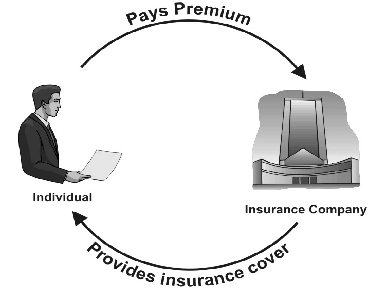
In ordinary language, the term premium denotes the price that is paid by an insured for purchasing an insurance policy. It is normally expressed as a rate of premium per thousand rupees of sum assured. These premium rates are available in the form of tables of rates that are available with insurance companies.
Diagram 1: Premium
The rates that are printed in these tables are known as “Office Premiums”. They are typically level annual premiums which need to be paid every year. They are in most cases the same throughout the term and are expressed as an annual rate.
If the premium for a twenty year endowment policy for a given age is Rs. 4,800, it means that Rs. 4,800 has to be paid each year for twenty years.
However it is possible to have some policies in which the premiums are payable only in the first few years. Companies also have single premium contracts in which only one premium is payable at the beginning of the contract. These policies are usually investment oriented.
2. Rebates
Life insurance companies may also offer certain types of rebates on the premium that is payable. Two such rebates are:
• For sum assured
• For mode of premium
a) Rebate for sum assured
The rebate for sum assured is offered to those who buy policies with higher amounts of sum assured. It is offered as a way of passing on to the customer, the gains that the insurer may make when servicing higher value policies. The reason for this is simple. Whether an insurer services a policy for Rs.50,000 or Rs.5,00,000, the amount of effort required for both, and consequently, the cost of processing these policies remain the same. But higher sum assured policies yield more premium and so more profits.
b) Rebate for mode of premium
Similarly a rebate may be offered for the mode of premium. Life insurance companies may allow premiums to be paid on annual, half yearly, quarterly or monthly basis. More frequent the mode, more the cost of service. Yearly and half yearly modes involve collection and accounting only once a year while quarterly and monthly modes would mean the process is more frequent. Half-yearly or yearly premiums thus enable a saving in administrative costs as compared to quarterly or monthly modes. Moreover, in the yearly mode, the insurer can utilise this amount during the entire year and earn interest on it. Insurers would hence encourage payment via yearly and half yearly modes by allowing a rebate on these. They may also charge a little extra for monthly mode of payments, to cover additional administrative expenses involved.
3. Extra charges
The tabular premium is charged for a group of insured individuals who are not subject to any significant factors that would pose an extra risk. Such individual lives are known as standard lives and the rates charged are known as ordinary rates.
If a person proposing for insurance suffers from certain health problems like heart ailments or diabetes, which can pose a hazard to his life, such a life is considered to be sub-standard, in relation to other standard lives, the insurer may decide to impose an extra premium by way of a health extra. Similarly an occupational extra may be imposed on those engaged in a hazardous occupation, like a circus acrobat. These extras would result in the premium being more than the tabular premium.
Again, an insurer may offer certain extra benefits under a policy, which are available on payment of an extra premium.
A life insurer may offer a double accident benefit or DAB (where double the sum assured is payable as a claim if death is a result of accident). For this it may charge an extra premium of one rupee per thousand sum assured.
Similarly a benefit known as Permanent Disability Benefit (PDB) may be availed by paying an extra per thousand sum assured.
4. Determining the premium
Let us now examine how life insurers arrive at the rates that are presented in the premium tables. This task is performed by an actuary. The process of setting the premium in case of traditional life insurance policies like term insurance, whole life and endowment considers following elements:
• Mortality
• Interest
• Expenses of management
• Reserves
• Bonus loading
Diagram 2: Components of Premium
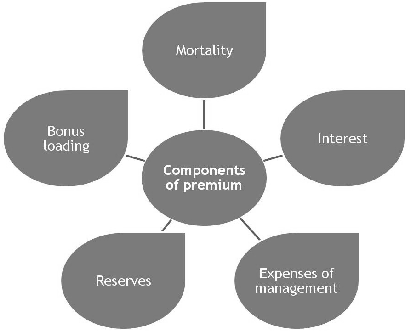
The first two elements constitute the net premium while the other elements are loaded onto the net premium to yield the gross or office premium
a) Mortality and Interest
Mortality is the first element in premiums. It is determined by using a “Mortality Table”, which gives us an estimate of the rate of mortality for different ages.
If the mortality rate for age 35 is 0.0035 it implies that out of every 1000 people who are alive as on age 35, 3.5 (or 35 out of 10,000) are expected to die between age 35 and 36.
The table may be used to calculate mortality cost for different ages. For example the rate of 0.0035 for age 35 implies a cost of insurance of 0.0035 x
1000 (sum assured) = Rs. 3.50 per thousand sum assured.
The above cost may be also called the “Risk Premium”. For higher ages the risk premium would be higher.
By summing up the individual risk premiums for different ages we can get the cost of claims that are expected to be payable for an entire period or term, say from age 35 to 55.The total cost of these claims would give us the future liabilities under a policy, in other words it tells us how much money is needed by us to pay claims that may arise in future.
To arrive at “Net Premium” the first step is to estimate the present value of future claim costs. The reason for estimating present value is that we are trying to find out how much we need at hand today to meet claims that may arise in the future. This process of estimating present value brings us to the next element in premium determination, namely “Interest”.
Interest is simply the discount rate we assume for arriving at the present value of future claim payments that have to be made.
If we need to have Rs. 5 per thousand to meet the cost of insurance after five years and if we assume a rate of interest of 6%, the present value of Rs.
5 payable after five years would be 5 x 1/ (1.06)5 = 3.74.
If instead of 6% we were to assume 10%, the present value would be only
3.10. In other words the higher the rate of interest assumed, the lower the
present value.
From our study of mortality and interest there are two major conclusions we can derive
• Higher the mortality rate in the mortality table, higher the premiums would be
• Higher the interest rate assumed, lower the premium
Actuaries tend to be prudent and a little conservative and would typically assume mortality rates that are higher than what they expect to be the actual experience. They would also assume a lower interest rate than what they expect to earn from their investments.
The discounted present value of all future claim liabilities gives the “Net Single Premium”. From the net single premium, we can get the “Net Level Annual Premium”. It is the net single premium which is levelled out so as to be payable over the premium paying term.
Diagram 3: Guiding Principles for determining Amount of Loading
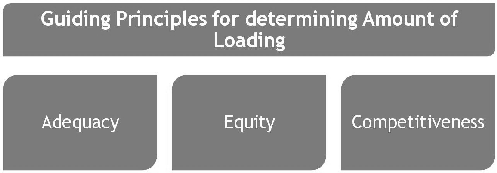
Gross premium is the net premium plus an amount called loading. There are three considerations or guiding principles that needs to be borne in mind when determining the amount of loading:
i. Adequacy
The total loading from all policies must be sufficient to cover the company’s total operating expenses. It should also provide a margin of safety and finally it should contribute to the profits or surplus of the company.
ii. Equity
Expenses and safety margins etc. should be equitably apportioned among various kinds of policies, depending on type of plan, age and term etc. The idea is that each class of policy should pay for its own costs, so that to the extent possible, one class of policy does not subsidise the other.
iii. Competitiveness
The resulting gross premiums should enable the company to improve its competitive position. If the loading is too high, it would make the policies very costly and people would not buy.
b) Expenses and reserves
Life insurers have to incur various types of operating expenses including:
• Agents training and recruitment,
• Commissions of agents,
• Staff salaries,
• Office accommodation,
• Office stationery,
• Electricity charges,
• Other miscellaneous etc.
All these have to be paid from premiums that are collected by insurers. These expenses are loaded to the net premium.
A life insurer incurs two types of expenses:
i. The first, known as “New Business Expenses”, are incurred at the beginning stage of the contract
ii. The second type of expenses, known as “Renewal Expenses,” is incurred during subsequent years.
Initial or new business expenses can be substantial. Life insurers are also required by law to hold certain margins as reserves to ensure they can meet their obligations, even when their actual experience is worse than assumed. The initial expenses along with the margins required to be maintained as reserves are typically higher than the initial premiums received.
The company thus faces a strain, known as new business strain. The initial outflow is only recovered from subsequent annual premiums. An implication is that life insurers cannot afford to have large number of their policies cancelled or lapsing in initial years, before the expenses are recouped. Another implication of new business strain is that life insurance companies would need a gestation period of some years before they can make profits.
Expenses are also determined in different ways, depending on the type of expense.
i. For instance, commissions and incentives for agency managers / development officers are typically decided as a percentage of the premiums earned.
ii. On the other hand, expenses like medical examiners’ fees and policy stamps vary depending on the amount of sum assured or face value of the policy and are considered in relation to the sum assured.
iii. A third category of expenses is overheads like salaries and rents which generally vary with the amount of activities that in turn depend on the number of policies being serviced. The larger the volume of business in terms of number of policies, higher the overhead expenses.
Based on the above classification, the typical loading to a net premium would have three parts
i. A percentage of premiums
ii. A constant amount for each ‘1000 sum assured’ (or face amount) which is added to net premium
iii. A constant amount per policy
The net premium and loading for expenses is designed to cover the estimated cost of benefits and expense charges that the life insurer expects to incur during the term of the policy. The insurer also constantly faces the risk that actual experience may be different from the assumptions made at the stage of designing the contract.
One source of risk is that of lapses and withdrawals. A lapse means that the policyholder discontinues payment of premiums. In case of withdrawals, the policyholder surrenders the policy and receives an amount from the policy’s acquired cash value.
Lapses can pose a serious problem because they typically happen within the first three years with highest incidence being typically in the very first year of the contract. Life insurers incorporate a loading in anticipation of leakages that may arise as a result.
Life insurers must also be prepared for the eventuality that the assumptions on basis of which they set their premiums differs from actual experience. Such a contingency can arise from two reasons.
i. Firstly the assumptions themselves may have been inappropriate. For example the life insurer may use a mortality table that does not reflect the current mortality or has not adequately factored for inflation
ii. Secondly there are random fluctuations that may belie the assumptions. There are three ways in which the above kind of risks can be addressed.
i. They can be passed on to the customer, for instance, in the case of investment-linked products like ULIP’s, the risk of lower returns has to be borne by the customer.
ii. A second way is to reinsure the policy with a reinsurer. In this case the mortality risk is borne by the reinsurer.
iii. The third and more commonly used way is to incorporate a loading margin in the premium, which could help to absorb the divergence between expected and actual experience.
c) With Profit policies and Bonus loading
Let us listen to what the actuary Brian Corby had to say about how With
Profit policies emerged.
“Some two hundred years ago, at the beginning of life insurance, the major uncertainty was the rate of mortality. The solution adopted was to charge excessive premiums. Of course they did not know that they were excessive in advance so that solvency was assumed, and then, when sufficient experience was accumulated to assess what the premiums should have been, to return the excess or some of it to policyholders by way of bonus additions. This was the origin of the traditional with profit policies we issue today…”
Participation in profits also ushered an element called “Bonus Loading” into premiums. The idea was to provide a margin for profits within the premium, such that it served as an added cushion against unforeseen contingencies and also paid for the policy’s share of surplus distributed (as bonus).The bonus loading feature is one reason why life insurers have been confident about their long term solvency and capital adequacy.
In sum we can say that:
If we assume that the above loadings together comprise a total of K percent of gross premium (GP), we can find out the gross premium, given the net premium (NP) as
For instance if the net single premium for an endowment policy is Rs. 380 and the loading factor, K is 50% then the gross premium would be Rs. 760.
What does a policy lapse mean?
I. Policyholder completes premium payment for a policy
II. Policyholder discontinues premium payment for a policy
III. Policy attains maturity
IV. Policy is withdrawn from the market
1. Determination of surplus and bonus
Every life insurance company is expected to undertake a periodic valuation of its assets and liabilities. Such a valuation has two purposes:
i. To assess the financial state of the life insurer, in other words to determine if it is solvent or insolvent
ii. To determine the surplus available for distribution among policyholders /share holders
Surplus is the excess of value of assets over value of liabilities. If it is negative, it is known as a strain.
Let us now see how the concept of surplus in life insurance is different from that of profit of a firm.
Firms in general have two concepts of profit. In the accounting sense, profit is defined as the excess of income over outgo for a given accounting period, it forms part of the profit and loss account. Profit also forms part of the balance sheet of a firm - it may be defined as the excess of assets over liabilities. The balance sheet also reflects the profits in the P&L account. In both instances, an ex-post approach is adopted for recognition of profits.
The profits of XYZ firm as on 31stMarch 2013, is given as its income less expenses or its assets less liabilities as on that date.
In both instances, the profit is clearly defined and is known.
Can we apply a similar argument and specify the liabilities and assets in case of a life insurance valuation?
In such a case, the surplus would be defined as
Where liabilities expected to arise for a block of policies are determined as present value of future claims, expenses and other expected payouts less the present value of premiums expected to be received on these policies
Diagram 4: Ways of Valuing Assets
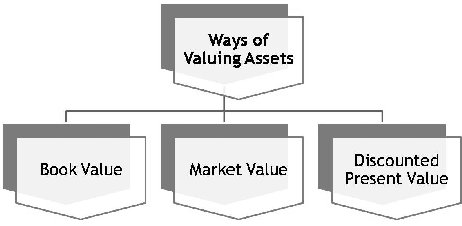
Assets are valued in one of three ways
i. At Book Value
This is the value at which the life insurer has purchased or acquired its assets
ii. At Market Value
The worth of the life insurer’s assets in the market place
iii. Discounted Present Value
Estimating the future income stream from various assets and discounting them to the present
The problem is that one cannot place an exact value on liabilities because one cannot precisely predict what will happen in the future. The value of liabilities depends on assumptions about factors like mortality, interest, expenses and persistency which are made while estimating the present value of future liabilities. It is for this reason that in life insurance we use the term surplus instead of profits.
Surplus is thus a function of how assets and liabilities are valued.
i. When a life insurer is very conservative in its valuation, it would result in liabilities being overvalued than otherwise while assets are undervalued. As a result the surplus that is declared would be reduced. This means lesser bonuses would be available for distribution among current policyholders. But it would also contribute to financial soundness of the insurer. This is because the actual amount of surplus is higher than the declared surplus and so higher provisions can be retained for the future. This would benefit future policyholders.
ii. On the other hand, if assets and liabilities are valued liberally, it has the opposite result. Current policyholders would be benefited at the expense of future ones.
The life insurance company has to strike the right balance between current and future policyholders.
2. Allocating the surplus
Surplus arises as a result of the life insurer’s actual experience being better than what it had assumed. Under with profit contracts, the life insurer is obliged to pass on the benefits of such a favourable gap (between the actual and expected results) to policyholders who have agreed to participate in the profits and have purchased these with profit policies.
At the same time, surplus is also the source from which the company’s basic capital (its equity or net worth) can be increased from within. In this sense, surplus of a life insurer is similar to an ordinary company’s profits which have not been distributed but have been retained. These are known as ‘retained earnings’. They contribute to its financial soundness.
Let us now see how the surplus that is determined would be allocated
a) Solvency requirements
Firstly, a part of the excess of assets over liabilities needs to be kept to protect policyholders in the event of unforeseen adversities in future. The solvency margin may be defined as that portion of surplus assets over liabilities specifically set aside as a cushion for addressing any unforeseen deviations between expected and actual experience.
b) Free assets
Another purpose for having surplus that is unallocated (for distribution) is to increase the level of free assets. Free assets are unencumbered. In other words they are not required for meeting any liabilities. The life insurer is thus free to use them. Life insurers need to maintain such free assets for two reasons.
i. Firstly companies need capital to finance the new business. We have already seen how they need to finance their new business strain.
ii. Free assets also offer the life insurer with greater leverage and freedom in choosing its investment strategies. This becomes vital for companies who need to generate and provide higher and more competitive returns.
Once the divisible surplus is declared, the next issue is to determine their distribution among the life insurer’s policyholders (after leaving a portion for distribution among shareholders if any). In India, the popular method for the purpose has been through the “Bonus Mechanism” where surplus is distributed in the form of a bonus. This system is popular in the United Kingdom, India and many other countries.
3. Bonus
Bonus is paid as an addition to the basic benefit payable under a contract. Typically it may appear as an addition to basic sum assured or basic pension per annum. It is expressed, for example, as Rs. 60 per thousand sum assured (or 60% of SA).
The most common form of bonus is the reversionary bonus. The company is expected to declare such bonus additions each year, throughout the lifetime of the contract. Once declared, they get attached and cannot be taken away. They form part of the liabilities of the company. They are called ‘Reversionary’ bonuses because the policyholder only receives them when the contract becomes a claim by death or maturity.
Bonuses may also be payable on surrender. In such cases it is often stipulated that the contract should have run for a certain term (say 5 years) to become eligible.
Diagram 5: Types of Reversionary Bonuses
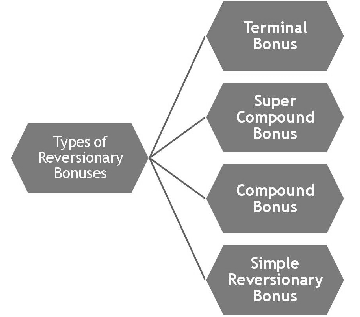
i. Simple Reversionary Bonus
This is a bonus expressed as a percentage of the basic cash benefit under the contract. In India for example, it is declared as amount per thousand sum assured.
ii. Compound Bonus
Here the company expresses a bonus as a percentage of basic benefit and already attached bonuses. It is thus a bonus on a bonus. A way to express it may be as @ 8% of basic sum assured plus attached bonus.
iii. Terminal Bonus
As the name suggests, this bonus attaches to the contract only on its contractual termination (by death or maturity). The bonus is declared only for claims of the ensuing year without any commitment about subsequent years (as in case of reversionary bonuses). Thus the terminal bonus declared for 2013 would only apply to claims that have arisen during 2013-14 and not for subsequent years.
Finally, terminal bonuses depend on the time duration of the contract, and increases as the duration increases. Thus the terminal bonus for a contract that has run for 25 years would be higher than one which has run for 15 years.
Terminal bonuses emerged (in UK) as a solution to the problem of how to treat large unrealised gains that were earned as a result of increased investment in shares and property. By giving these as one off payments and also relating them to time, the life insurance companies solved the problems of how to sustain these bonuses. They also became a way to achieve equity among policy holders
4. The Contribution Method
Another method of distribution of surplus which has been adopted in North America is the “Contribution” method. Under this method, consideration is given to three sources of surplus - excess interest, mortality savings and savings arising with respect to expense and other loadings.
The surplus is thus given by the difference between what was expected to happen and what actually happened over the year with respect to mortality, interest and expenses
The dividends that are declared may be used in one of the following four ways
i. It may be paid in the form of dividends in cash
ii. In the form of adjustment to, and reduction in future premiums
iii. A third method is to allow purchase of non-forfeitable paid up additions to the policy
iv. Finally dividends may be allowed to accumulate, with interest, to the credit of the policy. It may be either withdrawn at the option of policyholder or only at the end of the contract
5. Unit Linked Policies
Traditional “With Profit” policies, as discussed above, contain a linkage between the bonuses they pay and the investment performance of the life insurer. The linkage however is not direct. The policyholder’s bonus is determined by the surplus that is declared during the periodic valuation of the insurer’s assets and liabilities. As a result, the bonus structure does not directly reflect the value of the underlying assets of the insurer.
Again, bonuses under a valuation are generally only declared once a year. They obviously cannot reflect the daily fluctuations in the value of assets. Unit linked policies have been designed precisely to overcome some of the limitations spelt out above.
They involve a different approach to the design of products and follow a different set of principles.
a) Unitising
The distinctive feature of these policies is that their benefits are wholly or partially determined by the value of units credited to the policyholder’s account at the date when the claim payment is due to be made. A unit is created through the division of an investment fund into a number of equal parts.
b) Transparent structure
The charges for insurance protection and expenses component of a unit linked product are clearly specified. Once these charges are deducted from the premium the balance of the account and income from it is invested in units. The value of these units is fixed with reference to a pre-determined index of performance.
It is defined by a rule or formula, which is outlined in advance. Two independent persons, by following this formula, would arrive at the same estimate of benefits. Policy holder benefits, in other words, do not depend on the assumptions and discretions of the life insurance company
c) Pricing
In traditional plans like endowment, the insured decides the amount of sum assured to be purchased. This sum assured is guaranteed and the premium is set such that, under given assumptions of mortality, interest and expenses, it would be adequate to pay this amount. If the actual experience is better than the assumptions made while setting the premiums, the benefit is passed on in the form of a bonus.
Under unit linked policies, the insured decides what amount of premium he
/ she can contribute at regular intervals. The premium may vary, subject to
a minimum that may need to be paid. The insurance cover is a multiple of the premiums paid – for example it may be ten times the annual premium.
The premium is divided into three parts
i. Firstly there is a policy allocation charge (PAC) which is comprised of agents’ commission, policy setup costs, administrative costs and statutory levies.
ii. The second component is the mortality charge which is the cost of providing risk cover.
iii. The balance of premiums after meeting the above two, are allocated for the purchase of units.
The PAC as a proportion of the premiums is high in the initial years, both under traditional and ULIP plans. Under the former, these charges are apportioned and spread out throughout the policy term. In the case of ULIPs however they are deducted from the initial premiums itself. This implies that in the initial stages, the charges would significantly reduce the amount allocated for investment. This is why the value of the benefits, vis-à-vis the premiums paid, would be very low. It would in fact be less than the premiums paid in the early years of the contract.
d) The bearing of investment risk
Finally, since the value of the units depends on the value of the life insurer’s investments, there is a risk that these unit values may be lower than expected and result in the returns being low and even negative. The life insurer, while being expected to manage these investments in an efficient and prudent manner, does not give any guarantee about the unit values. The investment risk, in other words, is borne by the policyholder/unit holder. The life insurer may however bear the mortality and expense risk.
Who bears the investment risk in case of ULIPs?
I. Insurer
II. Insured
III. State
IV. IRDA
• In ordinary language, the term premium denotes the price that is paid by an insured for purchasing an insurance policy.
• The process of setting the premium for life insurance policies involves consideration of mortality, interests, expense management and reserves.
• Gross premium is the net premium plus an amount called loading.
• A lapse means that the policyholder discontinues payment of premiums. In case of withdrawals, the policyholder surrenders the policy and receives an amount from the policy’s acquired cash value.
• Surplus arises as a result of the life insurer’s actual experience being better than what it had assumed.
• Surplus allocation could be towards maintaining solvency requirements, increasing free assets etc.
The most common form of bonus is the reversionary bonus.
1. Premium
2. Rebate
3. Bonus
4. Surplus
5. Reserve
6. Loading
7. Reversionary bonus