In previous chapters we have covered various aspects of life insurance, including regulations. In this chapter we shall discuss about life insurance agency as a career. We shall consider the prospects in an agency career, the role of an agent and the requirements of being a good agent.
A. Insurance channels
B. Life insurance agency profession
C. Recruitment, training and licensing of agents
1. Who is an agent?
Agent and principal
As per Section 182 of the Indian Contract Act, an agent is a person employed to do any act for another or to represent another in dealing with a third person. The person for whom such act is done or who is represented is called the principal.
As per the Insurance Act, an agent is one who is licensed under Section 42 of the Act, authorised to be a salesman for insurance, and is paid commissions for soliciting, procuring and continuance of the business.
In India, when we speak of agent, we mean a tied agent – one who is allowed by law to represent only one life insurance company and sell its products.
It may be seen that the agent is an intermediary who comes between the life insurer and the customer.
2. Insurance channels
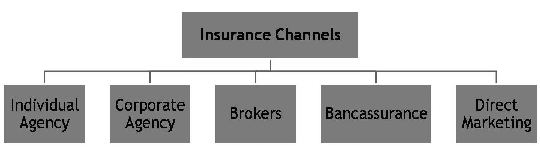
Until a few years ago, the agency channel was the only one that was in vogue. Today there are a range of other channels. It would be useful to know about some of these channels and how they work.
Diagram 1: Insurance channels
a) Corporate agency
It is a variant of the individual agency model. Here a corporate entity, which has its own set of customers, tries to reach out and sell insurance products. IRDA’s regulations clearly mandate that the “entity” needs to set up a separate unit with a Principle Officer and trained manpower which has undergone compulsory training from an institute recognised by the regulator.
b) Brokers
Both agents and brokers are intermediaries who interact between the insurance company and the customer. There is however a difference between the two.
Insurance agent |
Broker |
An insurance agent typically is a representative of the insurance company and is governed by the agent- principal relationship. The agent's primary relationship and responsibility is to the insurance company and not the insurance buyer. |
An insurance broker represents the insured and generally does not have any contractual agreement to exclusively serve any one insurance company. |
The agent is expected to faithfully represent his company and offer whatever is available in the company’s product line to the customer. |
Insurance broker is expected to represent the customer’s interest when choosing the right product and company that would best fit the customer’s particular needs. |
c) Bancassurance
The term ‘bancassurance’ refers to the collaboration between banks and insurers to distribute insurance products to the same customers or customer base. It has emerged as an important distribution channel globally and has risen in a relatively short time due to the benefits it offered over other channels in terms of operational cost and efficiencies. This was due to the wide consumer network that banks had access to. Bancassurance is today the main distributing channel for life insurance products in many of the European nations.
In India there are two broad Bancassurance models
i. One is where a bank becomes a corporate agent of an insurer and taps its customer base to sell insurance products. In this case the employees of the bank take up the task of selling the products of the insurance company
ii. A referral model, where the bank supports the insurance company with its data base, while the sale of insurance products is done by the insurance company.
Bancsassurance has gained much momentum as a preferred channel of marketing for some of the private life insurance companies in India and is a strong alternative to the agency channel.
d) Direct marketing
This is where the company directly markets to customers through its own sales force which is made up of employees of the company. They may get a regular salary and incentives, based on their sales performance.
Diagram 2: Direct marketing approaches
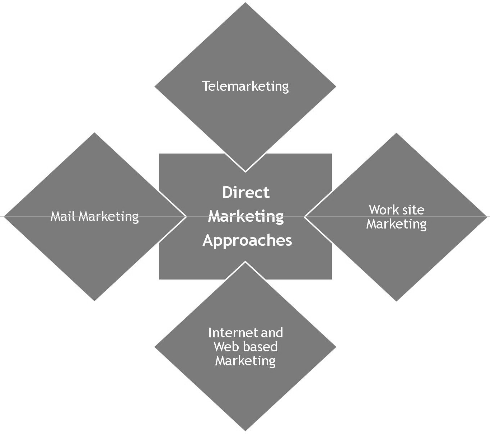
Direct marketing may involve various approaches like
i. Telemarketing (through call centres for instance);
ii. Mail marketing;
iii. Internet and web based marketing and
iv. Work site marketing
Here the life insurer directly communicates and solicits business with the prospective customer without going through an intermediary.
The presence of so many alternative marketing channels has no doubt made the marketplace more competitive and challenging. Nevertheless, life insurance agents who have acquired competence in selling and are able to build great relationships with their customers have continued to thrive and ascend to great heights in their profession.
Which of the below statements is incorrect?
I. An individual insurance agent is a representative of the insurance company and is governed by the agent-principal relationship.
II. An individual insurance agent's primary relationship and responsibility is to the insurance buyer and not the insurance company.
III. Insurance broker, who represents the insured, generally does not have any contractual agreement to exclusively serve any one insurance company
IV. Insurance broker is expected to represent the customer’s interest when choosing the right product and company that would best fit the customer’s particular needs.
The nature of the selling business in life insurance is quite different from others. Unlike other products, life insurance is intangible. One has to often create a need in the prospect’s mind and motivate the latter to buy life insurance. This involves a very high level of concept selling and thus life insurance sales persons are generally among the most accomplished of sales professionals. Since they are remunerated through commissions, there is no limit to what an agent can earn. The limit is set by whatever premium revenues the agent generates.
Apart from the scope to earn high incomes, an insurance agent can also attain a tremendous amount of job satisfaction and social respect if one’s job is done in an ethical and professional manner. The rewards and recognitions can be listed as:
i. Being recognised by the society as a knowledge worker and a professional.
ii. Being able to provide solutions to some of the most critical problems of people around is a matter of immense social value that life Insurance agents enjoy. Social prestige comes from being instrumental in financially helping out people who are affected by a misfortune.
How many jobs are as noble as helping a family which is orphaned by death of its bread winner, or helping to provide for someone in his old age?
iii. Being able to help people by advising them to take the right policy to cover their death or old age needs or an accident or an illness or meet other family needs can be a matter of immense personal satisfaction for life insurance agents.
iv. Agents deal with multiple clients and keep learning during their interactions. Over a period of time they become fairly knowledgeable in many areas simply by dealing with multiple experts. More significantly, they can become very skilled in dealing with various kinds of people, in understanding human emotions and being able to communicate and bring together people of various kinds. They can thus have the potential to be great community builders.
v. Finally, the life insurance agency is one of the few avocations where one can be an entrepreneur – it calls for little financial investment. No big educational or technical qualifications are needed to set up the business. One is master of oneself and has the freedom that comes from being one’s own employer. Of course with this freedom comes great responsibility and a successful life insurance agent quite often builds a brand around himself / herself by the quality of professional advise they provide; the trust that they inspire and the great friendships and relationships that they build.
Insurance agents have unique advantages of working as per their own career ambitions:
i. If an agent wishes to have a regular commission income, he will meet a fixed number of prospects or a fixed number of existing customers for renewal.
ii. If he wants to earn more commission, he will step up his efforts depending on his appetite for growth. He may even decide to be more active in some months and less active in other months based on his other priorities.
iii. If he has appetite for sales, he may be able to synergise with fields of life insurance, banking etc.
The work – life balance that one can achieve when one is working as per his own career ambitions is a plus point for insurance agents.
Let us now dwell a little on what kind of qualities or traits would contribute to success in the career as an insurance agent or advisor.
Diagram 3: Requirements for success in the life insurance agency profession
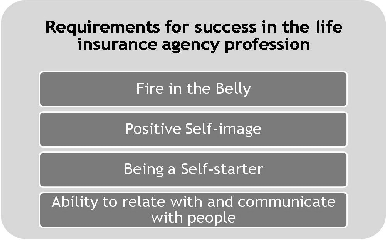
a) Fire in the belly
Perhaps the most important requirement is what we call ‘fire in the belly’. It is difficult to sustain in the profession unless one has a massive hunger to excel and significantly better one’s financial standing in the process. There are no free lunches in sales. Success has a price and one can pay that price only when there is sufficient fire within.
This hunger within is closely related to an entrepreneurial spirit – the ability to look at one’s work as an exciting adventure and look forward to a job environment where the only kind of job security comes from the ability to achieve results and the results don’t come easily. To some extent the ability to live with uncertainty can come from a background where work and life was challenging and every meal had to be earned the hard way. But this need not always be true.
b) Positive self-image
Unless one feels good inside, it is difficult to attract others to oneself. Take the profile of persons who are considered ‘difficult to get along with’ – hostile, pompous, negative, always giving excuses, complaining …. the list may be long – at the heart of it all, you would find an individual who feels insecure and inadequate.
This insecurity comes from a number of factors – like
i. the tendency to compare oneself with and consequently feel inferior to others;
ii. the obsession with looking good in others’ eyes;
iii. taking oneself too seriously and
iv. getting upset at the slightest attack on one’s self-image
One of the principal reasons for all the above is a bloated sense of ego and pre-occupation with oneself and one’s concerns. It is difficult for such a person to persist for long and consistently perform in sales.
c) Being a self-starter
How much are you self-driven and independent of others. Stephen Covey in his popular and path breaking work, “The seven habits of highly effective people” has put it as the first habit – he terms it the “inside out approach” as contrasted with the “outside in approach”.
In essence, it is about where the locus of control of one’s life and destiny resides - outside of or within oneself. Ineffective people, according to Covey, are typically seeking to fix responsibility on “someone - somewhere - out there” for all that has happened to them. People in this frame of mind may be okay in a work setting where they are led and supervised by others. No agent goes very far with such an approach.
d) Ability to relate with and communicate with people
To be a top producer, one would need to be at home with the persons who are one’s prospective customers. These may often be individuals with lots of money and egos, difficult to please and demanding in nature. The ability to relate and connect with people is a great gift. It calls for an ability to feel what other people feel and put oneself in the other’s shoes. At the same time one cannot let one’s feelings run riot and take charge of one’s business sense.
It would also not do to be an introvert. The whole business is after all about reaching out to others, making friends and influencing people. A sales person succeeds only when he or she extends affection and care to as wide a circle as possible. Almost everyone has to be a friend. At the same time one has to learn to take it in stride when others do not reciprocate – when they say no.
In 1964, an interesting study on “What makes a good salesman” was published in Harvard Business Review. The authors, David Mayer and Herbert M. Greenberg, after seven years of intensive field research, came up with an interesting insight.
They found that a good salesman should have two basic qualities: empathy and ego drive.
i. Empathy is the ability to feel as the other person does in order to be able to sell him a product or service. A sales person needs to be more sensitive to what goes on in the customer’s mind and adopt one’s approach and communicate accordingly.
ii. Ego drive refers to the sales person’s intense drive and effort to make the sale, not merely for the money to be gained, but because it is a personal need one simply has to fulfil.
In other words great sales people typically have a massive hunger to excel and to improve their financial standing in the process. They also have an entrepreneurial spirit – the ability to see their work as an exciting adventure and look forward to a job environment where security comes from the ability to achieve results. They also have the ability to relate and connect with people. They are comfortable in networking with others, making friends and influencing them.
Ethics is derived from the ancient Greek word ethos, which means customs or habits. In popular language, the term ‘Ethics’ is used to denote a set of principles for morally correct behaviour. An ethical person is one who has character, who lives by principles and demonstrates morally correct behaviour. It essentially means not just doing what one has a right to do but to ensure that one does the right things. In the work place it implies acting with honesty and integrity in one’s all dealings with customers and all other associates.
a) Golden rules
Golden rules of ethics are seen in many religious teachings. To give a few instances:
i. Hinduism: “Good people proceed while considering that what is best for others is best for them, too”. (Hitopdesha, Hinduism)”.
ii. Judaism: “Thou shalt regard thy neighbour as thyself. (Leviticus 19:18, Judaism)”.
iii. Christianity: “All things whatsoever ye would that men should do to you, do ye even so to them. (Matthew 7:12, Christianity)”.
iv. Buddhism: “Hurt not others with that which pains yourself. (Udanavarga
v. Confucianism: “What you do not want done to yourself, do not to others. (Analects 15:23, Confucianism)”.
vi. Islam: “No one of you is a believer until he loves for his brother what he loves for himself. (Traditions, Islam)”.
b) Ethics at work Some very basic ethical principles to be followed:
• Do good and avoid harm
• Be fair
• Keep your word
• Be true to yourself
• The prospect
• The company
• The profession
• Allied professionals
• Oneself and others related to us and
• Society and its laws
A vital element for the success of any life insurance or other financial service company is a strong commitment to high standards of business practices and market conduct in the insurance and financial marketplace.
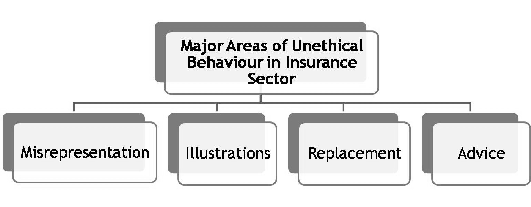
Diagram 4: Major areas of unethical behaviour in insurance sector Four major areas of unethical behaviour have been identified in the insurance sector:
i. Misrepresentation
ii. Illustrations
iii. Replacement and
iv. Advice
Let us look at each of these
i. Misrepresentation: stating one thing as another
Any advertisement for insurance is considered unfair if it fails to identify the product as insurance and this is applicable to advertisements by the company and its agents. The agent has to comply with rules at the point of sale such as explaining the exact benefits and features of the insurance product. The regulation mentions that that the scope of insurance benefits should be clearly stated in the prospectus that is shown to the prospect
ii. Illustrations
All companies follow a standard format for providing sales illustrations. It is mandatory to provide illustrations with two scenarios, one optimistic and one conservative, in respect to likely returns. It is considered unethical to present only one scenario and suggest that the illustrated one will be correct. According to 2008 IRDA guidelines on ULIPs, the policy holder must sign the business illustration along with the proposal form.
iii. Replacement
Surrender, reduced in amount, changed to reduced paid-up insurance, changed to extended term insurance, taking a policy loan to buy a new policy, more than 25% withdrawal from an existing plan to buy a new plan or lapse of an existing policy to purchase a new policy is not generally in the best interests of the policy holder.
iv. Advice
Do not give any legal or tax advice if you are not an attorney or a CA.
In recent years the issue of mis-selling has acquired much significance and has been the subject of much outcry. This is in part due to the crisis of confidence arising in the industry with respect to problems of market conduct.
Mis-selling may take various forms – like policies being sold without proper reference to the needs of the buyer or his/ her risk appetite; benefits to be received being illustrated without spelling out what is the price / cost the customer actually has to pay; benefits of investment linked policies illustrated, but the customer not told that these benefits are not guaranteed but depends on investment performance of the insurer.
Mis-selling has multiple impacts that are adverse to all participants. The companies and the industry as a whole get a bad name and this is reflected in loss of business and decline of growth. Agents and other sales persons, who
have mis-sold, sooner or later lose all their credibility in the market as customers who have had bitter experiences with these individuals, bad mouth about them to others. Finally the general loss of confidence of customers can result in life insurance no longer being a product people want to buy. This can have serious social consequences because it also results in large sections of people who need the benefits of insurance being denied it.
c) Code of ethical conduct
It would perhaps be relevant to reproduce here some of the Insurance Marketplace Standards Association (IMSA) principles:
Principle 1 |
To conduct business according to high standards of honesty and fairness and to render that service to its customers which, in the same circumstances, it would apply to or demand for itself. |
Principle 2 |
To provide competent and customer-focused sales and service. |
Principle 3 |
To engage in active and fair competition. |
Principle 4 |
To provide advertising and sales material that is clear as to purpose and honest and fair as to content. |
Principle 5 |
To provide for fair and expeditious handling of customer complaints and disputes. |
Principle 6 |
To maintain a system of supervision and review that is reasonably designed to achieve compliance with these principles of ethical market conduct. |
d) IRDA code of ethics and market conduct for agents
Let us look at the code of ethics and market conduct for agents prescribed by the IRDA. These are listed below.
i. Identify himself and the insurance company of whom he is an insurance agent;
ii. Disclose his licence to the prospect on demand;
iii. Disseminate the requisite information in respect of insurance products offered for sale by his insurer and take into account the needs of the prospect while recommending a specific insurance plan;
iv. Disclose the scales of commission in respect of the insurance product offered for sale, if asked by the prospect;
v. Indicate the premium to be charged by the insurer for the insurance product offered for sale;
vi. Explain to the prospect the nature of information required in the proposal form by the insurer, and also the importance of disclosure of material information in the purchase of an insurance contract;
vii. Bring to the notice of the insurer any adverse habits or income inconsistency of the prospect, in the form of a report (called “Insurance Agent’s Confidential Report”) along with every proposal submitted to the insurer, and any material fact that may adversely affect the underwriting decision of the insurer as regards acceptance of the proposal, by making all reasonable enquiries about the prospect;
viii. Inform promptly the prospect about the acceptance or rejection of the proposal by the insurer;
ix. Obtain the requisite documents at the time of filing the proposal form with the insurer; and other documents subsequently asked for by the insurer for completion of the proposal;
x. Render necessary assistance to the policyholders or claimants or beneficiaries in complying with the requirements for settlement of claims by the insurer;
xi. Advise every individual policyholder to effect nomination or assignment or change of address or exercise of options, as the case may be, and offer necessary assistance in this behalf, wherever necessary;
i. Solicit or procure insurance business without holding a valid licence;
ii. Induce the prospect to omit any material information in the proposal form;
iii. Induce the prospect to submit wrong information in the proposal form or documents submitted to the insurer for acceptance of the proposal;
iv. Behave in a discourteous manner with the prospect;
v. Interfere with any proposal introduced by any other insurance agent;
vi. Offer different rates, advantages, terms and conditions other than those offered by his insurer;
vii. Demand or receive a share of proceeds from the beneficiary under an insurance contract;
viii. Force a policyholder to terminate the existing policy and to effect a new proposal from him within three years from the date of such termination;
ix. Apply for fresh licence to act as an insurance agent, if his licence was earlier cancelled by the designated person, and a period of five years has not elapsed from the date of such cancellation;
x. Become or remain a director of any insurance company;
Every insurance agent shall, with a view to conserve the insurance business already procured through him, make every attempt to ensure remittance of the premiums by the policyholders within the stipulated time, by giving notice to the policyholder orally and in writing
What is meant by ‘professional’?
Webster’s dictionary uses the term professional in two ways:
i. One is the following of a profession for gain or livelihood
ii. Second sense is in terms of conduct, aims, or qualities that characterise or mark a profession or a professional person.
Let us look at the second definition a little more closely.
a) Characteristics of professionals
If we look at some of the professionals we meet regularly like doctors, lawyers or chartered accountants, we would notice certain distinctive characteristics:
i. Firstly that they have been qualified through an extensive process of education and possess a sound amount of knowledge that has been systematically acquired.
ii. Secondly, we would observe that they bring a high degree of technical skill to what they do. They adhere to certain accepted rules of practice which has been scientifically derived by the profession over long years of experience. Though doctors and surgeons may have various degrees of skill, they follow a certain tried and tested procedure which is objective.
iii. Thirdly they adhere to a high degree of ethical standards. In particular this means putting the customers’ interests above self-interest and also adherence to morally correct conduct and behaviour.
iv. A fourth characteristic of professionalism is a commitment to lifelong learning and continuous professional development. Many professions typically have professional bodies or associations that have been set up to promote the interests of the profession, including supporting and enabling their members to continually improve their knowledge and enhance their skills.
In 1964, Harvard Business Review published a study on “What makes a good salesman”. The authors came up with an interesting insight. They found that a good salesman should have two basic qualities. Which are those two qualities?
I. Affection and zeal to succeed
II. Patience and pro-activeness
III. Empathy and ego drive
IV. Hunger for growth and self-confidence
In India, the IRDA regulations with regard to agents have been designed with a view to bring in an element of professionalism into the life agency business. Let us consider some of these.
1. Agent regulations
a) Mandated minimum qualification levels of an agent
The regulator has prescribed that the applicant, willing to be recruited as an individual agent of a life insurance company, must have passed Standard XII examination or equivalent by any board or institution. In case of rural areas (having population of less than 5000, as per the last census) the applicant must have passed Standard X or equivalent
b) Pre-recruitment practical training
When an application is seeking licence for the first time, he / she is supposed to undergo 50 hours (75 hours in case the candidate has applied for composite licence) of practical training (from an approved institution) in life insurance. However, if the applicant possesses additional qualification, then the practical training requirement is relaxed.
c) Examination
Post the practical training, the applicant needs to take the examination, conducted by Insurance Institute of India (III) or any other approved examination body
d) Issue of Licence
After confirming that the applicant
i. possesses the minimum qualification required;
ii. had undergone the practical training;
iii. had passed the examination;
iv. had the knowledge to seek and gain insurance business and
v. was capable of providing the necessary service to the policyholders,the designated officer of the insurance company may issue licence to the applicante) Ethics and code of conduct
The agent is constantly bound by the ethics and code of conduct.
f) Renewal of Licence
The licence issued to the agent is valid for three years and needs to be renewed. Before the licence could be renewed, the applicant needs to undergo renewal training of 25 hours (35 hours in case of composite licence) from an approved institution.
g) Cancellation of Licence
The designated officer of the insurance company may cancel the licence if the agent suffers from any of the disqualifications like:
i. Being of unsound mind;
ii. Has been found guilty of any criminal misappropriation, breach of trust, forgery, cheating etc.;
iii. Has participated in any fraud, dishonesty or misrepresentation against the insured or the insurer;
iv. Has not followed any code of conduct etc. Mentioned in sub-section (4) of Section 42 of the Insurance Act, 1938
2. Guidelines on persistency for individual agents
Persistency during a period has been defined as “proportion of policies remaining in force at the end of the period out of the total policies in force at the beginning of the period.”
In other words, persistency is the percentage of business retained without lapsing or without being surrendered. Low persistency means high lapsation and vice versa. The persistency scores could be computed premium-wise as well as policy number-wise.
It has been observed that the quality of sale does impact the persistency rate of the policies. If the quality of sale has been high or good (which means that the solution offered is based on the need(s) of the client, the policyholder would not want to lapse or surrender the policy and eventually, its persistency would be higher and vice versa.
All this while, the agent was not held accountable for low persistency and it was only the insurer, who had to bear the brunt for low persistency. However, effective July 1st, 2014, this would change as soon as the guidelines on persistency get implemented.
3. Standard proposal form
This standard proposal form comprises of different sections. The section, pertaining to details of the prospects, needs of the prospects and the agent’s recommendation thereto, is compulsory. The insurers are also required to establish a system to measure the adequacy of the analysis of the client’s needs done with the appropriateness of recommendations made.
Million Dollar Round Table (MDRT)
Founded in 1927, MDRT is an international, independent association with several thousand members representing hundreds of life insurance companies in 76 countries.
MDRT members are internationally recognised as the standard of sales excellence in the life insurance and financial services industry - they are professionals / advisors who serve their clients by exemplary performance and the highest standards of ethics, knowledge, service and productivity.
How does an agent grow into a professional and then move up the career graph to become a champion sales producer in the agency business?
To answer this question, it is necessary to understand the role that a life insurance agent is expected to play. When we use the term “Role” it implies the distinctive way in which the agent adds value to his or her customer.
4. Agency function
The agency function consists of two distinctive tasks:
i. Building a relation with the customer – which inspires trust and confidence.
ii. Providing expert financial advice to the customer – which enables the latter to meet his or her needs for insurance in the most appropriate manner.
Let us see how these two functions evolve as an agent advances on a career path towards success and becomes a sales champion. An agent’s development could indeed be envisaged as progressing through three stages:
This is the stage when an agent has circle of personal contacts where he tries to push one or two products and their benefits. He is largely ‘shaking hands’ and getting customers to buy what he has. Sometimes the agent is lucky - the prospect has been looking for a particular product or solution or sometimes insurance may be taken as a personal favour. Many agents drop off here - the rejection, the sense of uncertainty and the loss of self-esteem are just too much to bear.
The second stage is set when the agent goes beyond mere ‘hand shake’ into
and is skilled at offering financial advice that is unbiased and in the best interests of his or her client.
This is also the stage when the agent begins to cultivate deeper relationships with a larger and larger circle of clients and begins to earn a stream of renewal commissions from the circle of clients that he has built. Productivity mounts as the agent is now able to achieve a higher conversion rate (turning prospects into buyers). Blind groping gives way to working to a plan – he is now engaged more and more in various kinds of personal and community service and other activities, building goodwill and acquiring a reputation for professionalism. He gets continual referrals and is the person to contact when people want to plan their life cycle investments.
The third stage is when the agent progresses to become a sort of social entrepreneur – the CEO of an enterprise, providing insurance and investment advice and other personal financial services. The enterprise thrives on a 360 degree relationship with a large circle of customers, and may even help the clients to secure services of other enterprises / service providers with which one is networked. The result is to make a range of service and support systems available at the customer’s doorstep – from filing income tax returns, to holiday planning, to making a will, to advice on health or education. The firm thrives on a lifetime partnership with a large network of clients.
Proportion of policies remaining in force at the end of the period out of the total policies in force at the beginning of the period is referred to as
I. Persistency
II. Consistency
III. Uniformity
IV. Reliability
• As per the Insurance Act, an agent is one who is licensed under Section 42 of the Act, authorised to be a salesman for insurance, and is paid commissions for soliciting, procuring and continuance of the business.
• Apart from individual agency, other insurance channels include:
• Corporate agency
• Brokers
• Bancassurance
• Direct marketing
• Through an agency career, apart from the scope to earn high incomes, an insurance agent can also attain a tremendous amount of job satisfaction and social respect if one’s job is done in an ethical and professional manner.
• Qualities that would contribute to success in the career as an insurance agent or advisor include:
• Fire in the belly
• Positive self-image
• Being a self-starter
• Ability to relate and communicate with people
• A good salesman should have two basic qualities: empathy and ego drive
• Four major areas of unethical behaviour have been identified in the insurance sector:
• Misrepresentation
• Illustrations
• Replacement
• Advice
• The IRDA has prescribed a code of ethics and market conduct for agents
• IRDA has laid down the regulations for recruitment, training and licensing of insurance agents.
• Effective September 2012, a standard proposal form has been adopted by all life insurers for all individual policies. This is based on the draft exposure guidelines issued by IRDA in June 2012.
• The Agency Function consists of two distinctive tasks:
• Building a relation with the customer – which inspires trust and confidence
• Providing expert financial advice to the customer – which enables the latter to meet his or her needs for insurance in the most appropriate manner
1. Corporate agency
2. Bancassurance
3. Professionalism
4. Persistency