CHAPTER 20
GRIEVANCE REDRESSAL MECHANISM
Chapter Introduction
Insurance industry is essentially a service industry where, in the present context, customer expectations are constantly rising and dissatisfaction with the standard of services rendered is ever present. Despite there being continuous product innovation and significant improvement in the level of customer service aided by use of modern technology, the industry suffers badly in terms of customer dissatisfaction and poor image. Alive to this situation the Government and the regulator have taken a number of initiatives.
IRDA’s regulations stipulate the turnaround times (TAT) for various services that an insurance company has to render the consumer. These are part of the IRDA (Protection of Policyholders’ Interests Regulations), 2002.Insurance companies are also required to have an effective grievance redressal mechanism and IRDA has created the guidelines for that too.
Learning Outcomes
A. Grievance redressal mechanism- consumer courts, ombudsman
A. Grievance redressal mechanism
1. Integrated Grievance Management System (IGMS)
IRDA has launched an Integrated Grievance Management System (IGMS) which acts as a central repository of insurance grievance data and as a tool for monitoring grievance redress in the industry.
Policyholders can register on this system with their policy details and lodge their complaints. Complaints are then forwarded to the respective insurance companies.
Grievance redressal mechanism
IGMS tracks complaints and the time taken for their redressal. The complaints can be registered at the following URL:
http://www.policyholder.gov.in/Integrated_Grievance_Management.aspx
2. The Consumer Protection Act, 1986
Important
This Act was passed “to provide for better protection of the interest of consumers and to make provision for the establishment of consumer councils and other authorities for the settlement of consumer’s disputes”. The Act has been amended by the Consumer Protection (Amendment) Act, 2002.
Some definitions provided in the Act are as follows:
Definition
“Service” means service of any description which is made available to potential users and includes the provision of facilities in connection with banking, financing, insurance, transport, processing, supply of electrical or other energy, board or lodging or both, housing construction, entertainment, amusement or the purveying of news or other information. But it does not include the rendering of any service free of charge or under a contract of personal service. Insurance is included as a service
“Consumer” means any person who
• Buys any goods for a consideration and includes any user of such goods.
But it does not include a person who obtains such goods for resale or for
any commercial purpose or
• Hires or avails of any services for a consideration and includes beneficiary of such services.
“Defect” means any fault, imperfection, shortcoming inadequacy in the quality, nature and manner of performance which is required to be maintained by or under any law or has been undertaken to be performed by a person in pursuance of a contract or otherwise in relation to any service.
“Complaint” means any allegation in writing made by a complainant that:
• an unfair trade practice or restrictive trade practice has been adopted
• the goods bought by him suffer from one or more defects
• the services hired or availed of by him suffer from deficiency in any respect
• price charged is in excess of that fixed by law or displayed on package
• goods which will be hazardous to life and safety when used are being
offered for sale to the public in contravention of the provisions of any law
requiring trader to display information in regard to the contents, manner
and effect of use of such goods
“Consumer dispute” means a dispute where the person against whom a complaint has been made, denies and disputes the allegations contained in the complaint.
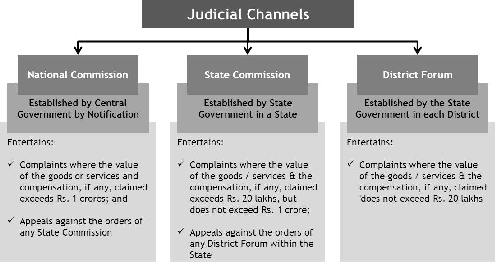
a) Consumer disputes redressal agencies
“Consumer disputes redressal agencies” are established in each district and state and at national level.
i. District Forum
• The forum has jurisdiction to entertain complaints, where value of the goods or services and the compensation claimed is up to Rs.20 lakhs.
• The District Forum is empowered to send its order/decree for execution to appropriate civil court.
ii. State Commission
• This redressal authority has original, appellate and supervisory jurisdiction.
• It entertains appeals from the District Forum.
• It also has original jurisdiction to entertain complaints where the value of goods/service and compensation, if any claimed exceeds Rs.
20 lakhs but does not exceed Rs. 100 lakhs.
• Other powers and authority are similar to those of the District Forum.
iii. National Commission
• The final authority established under the Act is the National Commission.
• It has original, appellate as well as supervisory jurisdiction.
• It can hear the appeals from the order passed by the State Commission and in its original jurisdiction it will entertain disputes, where goods/services and the compensation claimed exceeds Rs.100 lakhs.
• It has supervisory jurisdiction over State Commission.
All the three agencies have powers of a civil court.
Diagram 2: Channels for grievance redressal
b) Procedure for filing a complaint
The procedure for filing a complaint is very simple in all above three redressal agencies. There is no fee for filing a complaint or filing an appeal whether before the State Commission or National Commission. The complaint can be filed by the complainant himself or by his authorised agent. It can be filed personally or can even be sent by post. It may be noted that no advocate is necessary for the purpose of filing a complaint.
c) Consumer Forum Orders
If the forum is satisfied that the goods complained against suffer from any of the defects specified in the complaint or that any of the allegations contained in the complaint about the services are proved, the forum can issue an order directing the opposite party to do one or more of the following namely,
i. To return to the complainant the price, (or premium in case of insurance), the charges paid by the complainant
ii. To award such amount as compensation to the consumers for any loss or injury suffered by the consumer due to negligence of the opposite party
iii. To remove the defects or deficiencies in the services in question
iv. To discontinue the unfair trade practice or the restrictive trade
practice or not to repeat them
v. To provide for adequate costs to parties
d) Nature of complaints
The majority of consumer disputes with the three forums fall in the following main categories as far as insurance business are concerned
i. Delay in settlement of claims
ii. Non-settlement of claims
iii. Repudiation of claims
iv. Quantum of loss
v. Policy terms, conditions etc.
3. The Insurance Ombudsman
The Central Government under the powers of the Insurance Act, 1938 made Redressal of Public Grievances Rules, 1998 by a notification published in the official gazette on November 11, 1998. These rules apply to life and non-life insurance, for all personal lines of insurances, that is, insurances taken in an individual capacity.
The objective of these rules is to resolve all complaints relating to settlement of claim on the part of the insurance companies in a cost effective, efficient and impartial manner.
The Ombudsman, by mutual agreement of the insured and the insurer can act as a mediator and counsellor within the terms of reference.
The decision of the Ombudsman, whether to accept or reject the complaint, is final.
a) Complaint to the Ombudsman
Any complaint made to the Ombudsman should be in writing, signed by the insured or his legal heirs, addressed to an Ombudsman within whose jurisdiction, the insurer has a branch/ office, supported by documents, if any, along with an estimate of the nature and extent of loss to the complainant and the relief sought.
Complaints can be made to the Ombudsman if:
i. The complainant had made a previous written representation to the insurance company and the insurance company had:
• Rejected the complaint or
• The complainant had not received any reply within one month after receipt of the complaint by the insurer
ii. The complainant is not satisfied with the reply given by the insurer
iii. The complaint is made within one year from the date of rejection by the insurance company
iv. The complaint is not pending in any court or consumer forum or in arbitration
b) Recommendations by the Ombudsman
There are certain duties/protocols that the Ombudsman is expected to follow:
i. Recommendations should be made within one month of the receipt of such a complaint
ii. The copies should be sent to both the complainant and the insurance company
iii. Recommendations have to be accepted in writing by the complainant within 15 days of receipt of such recommendation
iv. A copy of acceptance letter by the insured should be sent to the insurer and his written confirmation sought within 15 days of his receiving such acceptance letter
c) Award
If the dispute is not settled by intermediation, the Ombudsman will pass an award to the insured which he thinks is fair, and is not more than what is necessary to cover the loss of the insured.
The awards by Ombudsman are governed by the following rules:
i. The award should not be more than Rs.20 lakh (inclusive of ex-gratia payment and other expenses)
ii. The award should be made within a period of 3 months from the date of receipt of such a complaint, and the insured should acknowledge the receipt of the award in full as a final settlement within one month of the receipt of such award
iii. The insurer shall comply with the award and send a written intimation to the Ombudsman within 15 days of the receipt of such acceptance letter
iv. If the insured does not intimate in writing the acceptance of such award, the insurer may not implement the award
Test Yourself 1
The has jurisdiction to entertain complaints, where value of
the goods or services and the compensation claimed is up to Rs.20 lakhs.
I. District Forum
II. State Commission
III. Zilla Parishad
IV. National Commission
Summary
• IRDA has launched an Integrated Grievance Management System (IGMS) which acts as a central repository of insurance grievance data and as a tool for monitoring grievance redress in the industry.
• Consumer disputes redressal agencies are established in each district and state and at national level.
• As far as insurance business is concerned, the majority of consumer disputes fall in categories such as delay in settlement of claims, non- settlement of claims, repudiation of claims, quantum of loss and policy terms, conditions etc.
• The Ombudsman, by mutual agreement of the insured and the insurer can act as a mediator and counsellor within the terms of reference.
• If the dispute is not settled by intermediation, the Ombudsman will pass award to the insured which he thinks is fair, and is not more than what is necessary to cover the loss of the insured.
Key Terms
1. Integrated Grievance Management System (IGMS)|
2. The Consumer Protection Act, 1986
3. District Forum
4. State Commission
5. National Commission
6. Insurance Ombudsman