An agent who renders service and builds close relationships with customers;
builds goodwill and brand value, which helps in expanding the business.
In this chapter you will learn the importance of customer service. You will learn the role of agents in providing service to customers. You will also learn how to communicate and relate with the customer.
A. Importance of customer service
B. Insurance agent’s role in providing great customer service
C. Communication skills
1. Why customer service?
Customers provide the bread and butter of a business and no enterprise can afford to treat them indifferently. The role of customer service and relationships is far more critical in the case of insurance than in other products. This is because insurance is a service and very different from real goods.
Let us examine how buying insurance differs from purchasing a car.
Car |
Insurance of the car |
It is a tangible good, that can be seen, test driven and experienced. |
It is a contract to compensate against loss or damage to the car due to an unforeseen accident in future. One cannot see or touch or experience the insurance benefit till the unfortunate event occurs. |
The buyer of the car has an expectation of some pleasure at the time of purchase. The experience is real and easy to understand. |
The purchase of insurance is not based on expectation of immediate pleasure, but fear / anxiety about a possible tragedy. It is unlikely that any insurance customer would look forward to a situation where the benefit becomes payable. |
A car is produced in a factory assembly line, sold in a showroom and used on the road. The three processes of making, selling and using take place at three different times and places. |
In case of insurance it can be seen that production and consumption happen simultaneously. This simultaneity of production and consumption is a distinctive feature of all services. |
What the customer really derives is a service experience. If this is less than expected, it causes dissatisfaction. If the service exceeds expectations, the customer would be delighted. The goal of every enterprise should thus be to delight its customers.
2. Quality of service
It is necessary for life insurance companies and their personnel, which includes their agents, to render high quality service and delight the customer.
But what is high quality service? What are its attributes?
A well-known model on service quality (named “SERVQUAL”) would give us some insights. It highlights five major indicators of service quality:
a) Reliability: The ability to perform the promised service dependably and accurately. Most customers regard reliability as being the most important of the five dimensions of service quality. It is the foundation on which trust is built.
b) Responsiveness: Refers to the willingness and ability of service personnel to help customers and provide prompt response to the customer’s needs. It may be measured by indicators like speed, accuracy and attitude that are displayed while giving the service.
c) Assurance: Refers to the knowledge, competence and courtesy of service providers and their ability to convey trust and confidence. It is given by the customer’s evaluation of how well the service employee has understood needs and is capable of meeting them.
d) Empathy: Is described as the human touch. It is reflected in the caring attitude and individualised attention provided to customers.
e) Tangibles: Represent the physical environmental factors that the customer can see, hear and touch. For instance the location, the layout and cleanliness and the sense of order and professionalism that one gets when visiting a life insurance company’s office can make a great impression on the customer. The physical ambience becomes especially important because it creates first and lasting impressions, before and after the actual service is experienced.
3. Customer service and insurance
Ask any leading sales producers in the life insurance industry about how they managed to reach the top and stay there. You are likely to get a common answer, that it was the patronage and support of their existing clients that helped them build their business. You would also learn that a large part of their income comes from the commissions for renewal of the contracts. Their clients are also the source for acquiring new customers.
What is the secret of their success? The answer, most likely is, commitment to serving their customers.
How does keeping a customer happy benefit the agent and the company? To answer this question, it would be useful to look at customer’s lifetime value.
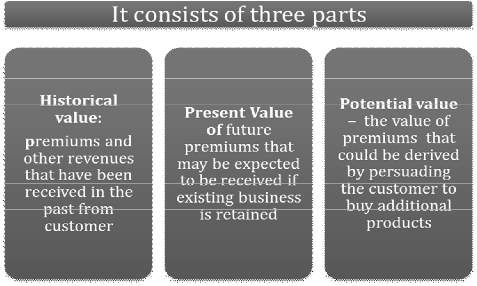
Customer lifetime value may be defined as the sum of economic benefits that can be derived from building a sound relationship with a customer over a long period of time.
Diagram 1: Customer lifetime value
An agent who renders service and builds close relationships with customers;
builds goodwill and brand value, which helps in expanding the business.
What is meant by customer lifetime value?
I. Sum of costs incurred while servicing the customer over his lifetime
II. Rank given to customer based on business generated
III. Sum of economic benefits that can be achieved by building a long term relationship with the customer
IV. Maximum insurance that can be attributed to the customer
Let us now consider how an agent can render great service to the customer. The role begins at the stage of sale and continues through the duration of the contract. Let us look at some of the milestones in a contract and the role played at each step.
The first point for service is the point of sale. One of the critical issues involved in purchase of life insurance is to determine the amount of coverage (sum assured) to be bought.
The agent really begins to earn her commission when she renders best advice on the matter. Life insurance products, as we have seen, are purchased to meet a range of protection and saving needs that arise during an individual’s lifetime.
The agent should be able to understand these needs and suggest products whose benefit features are most appropriate for meeting these needs.
The agent’s role is to relate to the customer as a coach and partner who would help him to manage his life contingent risk more effectively.
In other words the role of an insurance agent is more than that of a mere sales person. She also needs to be a personal financial planner and advisor, an underwriter, a designer of customised solutions and a relationship builder who thrives on building trust and long-term relationships, all rolled into one.
The agent has to support the customer in filling out the proposal for life insurance. The insured is required to take responsibility for the statements made therein.
It is very important that the agent should explain and clarify to the proposer the details to be filled as answer to each of the questions in the proposal form. In the event of a claim, a failure to give proper and complete information can jeopardize the customer’s claim.
Sometimes there may be additional information that may be required to complete the policy. In such cases the company may inform the customer directly or through the agent / advisor. In either case, it becomes necessary to help the customer complete all the required formalities and even explain to him or her why these are necessary.
a) First premium receipt (FPR)
It is the agent’s responsibility to ensure that the FPR is issued by the company to the insured. Promptness in this regard communicates to the client that his interests are safe in the hands of the agent and the company.
b) Delivery of the policy document
Delivery of the policy is another major opportunity that an agent gets to make contact with the customer. If company rules permit a policy document being delivered in person, it may be a good idea to collect it and present the document to the customer.
If the policy is being sent directly by mail, one must contact the customer, once it is known that the policy document has been sent. This is an opportunity to visit the customer and explain anything that is unclear in the document received. This is also an occasion to clarify various kinds of policy provisions and the policyholder’s rights and privileges that the customer can avail of. This act demonstrates a willingness to provide a level of service beyond the sale.
This meeting is also an occasion to pledge the agent’s commitment to serving the customer and communicating full support.
The next logical step would be to ask for the names and particulars of other individuals he knows who can possibly benefit from the agent’s services. If the client can himself contact these people and introduce the agent to them, it would mean a great breakthrough in business.c) Premium payment
The agent has to be in touch with the client to remind him / her of the premium payable so that the policy does not lapse. The relationship gets strengthened by keeping in touch with the client from time to time, by greeting him on some occasion like a festival or a family event. Similarly when there is a moment of difficulty or sorrow, by offering assistance, one demonstrates that one is available when needs.
The agent has a crucial role to play at the time of claim settlement. It is her /his task to ensure that the details of claim are immediately informed to the insurer and any claim investigation that may be necessary are supported to expedite the process.
The agent, by maintaining regular touch with her / his policyholders, can render other services to the policyholder such as arranging for prompt issue of duplicate policy, policy loan payment, change in nomination, assignment and facilitating revival of lapsed policies.
The time for high priority action is when the customer has a complaint. Remember that in the case of a complaint, the issue of service failure (it can range from delay in correcting the records of the insurer to a lack of promptness in settling a claim) which has aggrieved the customer is only a part of the story.
Customers get upset and infuriated a lot more because of their interpretations about such failure. There are two types of feelings and related emotions that arise with each service failure:
• Firstly there is a sense of unfairness, a feeling of being cheated.
• The second feeling is one of hurt ego – of being made to look and feel small.
A complaint is a crucial “moment of truth” in the customer relationship; if the company gets it right there is a potential to actually improve customer loyalty. The human touch is critical in this; customers want to feel that they are valued.
If you are a professional life insurance advisor, you would not allow such a situation to happen in the first place. You would take the matter up with the appropriate officer of the company. Remember, no one else in the company has ownership of the client’s problems as much as you do.
Complaints / grievances provide us the opportunity to demonstrate how much we care for the customer’s interests. They are in fact the solid pillars on which a life insurance agent’s goodwill and business is built. At the end of every policy document, the insurance companies have detailed the procedure of grievance, which should be brought to the notice of the customers at the time of explaining the document provisions.
In a customer’s mind, there are two types of feelings and related emotions that arise with each service failure on part of the insurance company. These feelings are
I. Confusion and empathy
II. Dishonesty and revenge
III. Ignorance and sympathy
IV. Sense of unfairness and hurt ego
1. Communication skills in customer service
One of the most important set of skills that an agent or service employee needs to possess, for effective performance in the work place, is soft skills.
Unlike hard skills – which deal with an individual’s ability to perform a certain type of task or activity - soft skills relate to one’s ability to interact effectively with other workers and customers, both at work and outside.
2. Communication and customer relationships
Customer service is one of the key elements in creating satisfied and loyal customers. But it is not enough. Customers are human beings with whom the company needs to build a strong relationship.
a) Elements that promote trust
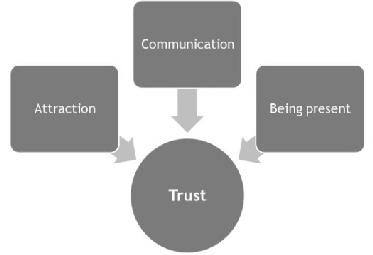
What goes to make a healthy relationship? At its heart, of course, there is trust. At the same time there are other elements, which reinforce and promote that trust.
Let us illustrateDiagram 1: Trust
i. Every relationship begins with attraction
One needs to be simply liked and must be able to build a rapport with the customer. Attraction is very often the result of first impressions that are derived when a customer comes in touch with the organisation or its representatives. Attraction is the first key to unlocking every heart.
Without attraction, a relationship is hardly possible. Consider a sales person who is not liked. Do you really think he or she will be able to make much headway in the sales career?
ii. The second element of a relationship is one’s presence – being there when needed:
The best example is perhaps that of a marriage. Is it important for the husband to be available when the wife needs him? Similarly in a customer relation, the issue is whether and how the company or its representative is available when needed. Is he or she fully present and listening to the customer’s needs?
iii. Communication
There may be instances when one is not fully present and is unable to do full justice to all the expectations of one’s customers. One can still maintain a strong relationship if one can speak to the customer, in a manner that is assuring, full of empathy and conveys a sense of responsibility.
All the above - the impression one creates, or the way one is present and listens, or the message one sends across to another – are dimensions of communication and call for discipline and skills. In a sense what one communicates is ultimately a function of how one thinks and sees.
Companies today emphasise a lot on customer relationship management since the cost of retaining a customer is far lower than that of acquiring a new customer. The customer relation occurs across many touch points e.g. while understanding a customer’s insurance needs, explaining policy cover, handing over forms. So, there are many opportunities for the agent to strengthen the relation at each of these points.
3. Process of communication
All communications require a sender, who transmits a message, and a recipient of that message. The process is complete once the receiver has understood the message of the sender.
Communication may take place in several forms:
• Oral,
• Written,
• Non-verbal and
• Using body language
It may be face to face, over the phone, or by mail or internet. It may be formal or informal. Whatever the content or form of the message or the media used, the essence of communication is given by what the recipient has understood as being communicated.
It is important for a business to choose how and when it will send messages to intended receivers.
4. Non-verbal communication
Let us now look at some concepts that the agent needs to understand.
a) Making a great first impression
We have already seen that attraction is the first pillar of any relationship. You can hardly expect to get business from a customer who does not like you. In fact many individuals need just a quick glance, of maybe a few seconds, to judge and evaluate you when you meet for the first time. Their opinion about you gets based on your appearance, your body language, your mannerisms, and how you are dressed and speak. Remember, first impressions last for long. Some useful tips for making a good first impression are:
i. Be on time always. Plan to arrive a few minutes early, allowing flexibility for all kinds of possible delays
ii. Present yourself appropriately. Your prospect, whom you are meeting for the first time, does not know you and your appearance is usually the first clue he or she has to go on.• Is your appearance helping to create the right first impression?
• Is the way you dress appropriate for the meeting or occasion?
• Is your grooming clean and tidy – with good haircut and shave, clean and tidy clothes, neat and tidy make up.iii. A warm, confident and winning smile puts you and your audience immediately at ease with one another
iv. Being open, confident and positive• Does your body language project confidence and self-assurance?
• Do you stand tall, smile, make eye contact, greet with a firm handshake?
• Do you remain positive even in the face of some criticism or when the meeting is not going as well as expected?v. Interest in the other person -The most important thing is about being genuinely interested in the other person.
• Do you take some time to find out about the customer as a person?
• Are you caring and attentive to what he or she says?
• Are you totally present and available to your customer or is your mobile phone engaging you during half your interview?b) Body Language
Body language refers to movements, gestures, facial expressions. The way we talk, walk, sit and stand, all say something about us, and what is happening inside us. It is often said that people listen to only a small percentage of what is actually said. What we don’t say speaks a lot more and a lot louder. Obviously, one needs to be very careful about one’s body language.
i. Confidence
Here are a few tips about how to appear confident and self-assured – giving the impression of someone to be seriously listened to:
• Posture – standing tall with shoulders held back
• Solid eye contact - with a "smiling" face
• Purposeful and deliberate gesturesii. Trust
Quite often, a sales person’s words fall on deaf ears because her audience does not trust her, her body language does not give the assurance that she is sincere about what she says. It is very important to be aware of some of the typical signs that may indicate when one is not honest and believable and be on guard against them as listed below:
• Eyes maintaining little or no eye contact, or rapid eye movements
• Hand or the fingers are in front of one’s mouth when speaking
• One’s body is physically turned away from the other
• One’s breathing rate increases
• Complexion changes colour; red in face or neck area
• Perspiration increases
• Voice changes such as change in pitch, stammering, throat clearing
• Speech – slow and clear with tone of voice kept moderate to lowSome body movements that indicate defensiveness and non-receptivity include:
• Hand / arm gestures are small and close to one’s body
• Facial expressions are minimal
• Body is physically turned away from you.
• Arms are crossed in front of body
• Eyes maintain little contact, or are downcastIf your customer expresses any of these, perhaps it is time you checked yourself and paid more attention to what is going on in the customer’s mind.
5. Listening skills
The third set of communication skills that one needs to be aware about and cultivate are listening skills. These follow from a well-known principle of personal effectiveness – ‘first to understand before being understood’. How well you listen has a major impact on your job effectiveness, and on the quality of your relationships with others. Let us look at some listening tips.
a) Active Listening: is where we consciously try to hear not only the words but also, more importantly, try to understand the complete message being sent by another.
Let us look at some of the elements of active listening. They are:
i. Paying Attention
We need to give the speaker our undivided attention, and acknowledge the message. Note, non-verbal communication also "speaks" loudly. Some aspects of attention are as follows:
• Look at the speaker directly
• Put aside distracting thoughts
• Don't mentally prepare a rebuttal!
• Avoid all external distractions (for instance, keep your mobile on silent mode)
• "Listen" to the speaker's body languageii. Demonstrating that you are listening
Use of body language plays an important role here. For instance one may:
• Give an occasional nod and smile
• Adopt a posture that is open and draws out the other to speak freely
• Have small verbal comments like yes and uh huh that encourage the speakeriii. Provide feedback
A lot of what we hear may get distorted by our personal filters, like the assumptions, judgments, and beliefs we carry. As a listener, we need to be aware of these filters and try to understand what really is being said.
• This may require you to reflect on the message and ask questions to clarify what was said
• Another important way to provide feedback is to paraphrase the speaker’s words
• Yet a third way is to periodically stop the speaker and make a summary of what the speaker has said and repeat it back to him or herExample
Asking for clarity: From what I have heard, am I right in assuming, that you have issues about the benefits of some of our saving plans, could you be more specific?
Paraphrasing the speaker’s exact words: So you are saying that ‘our saving plans are not providing benefits that are attractive enough’ – have I understood you correctly?
iv. Not being Judgmental
One of the biggest hurdles to active listening is our tendency to be judgmental and biased about the speaker. The result is that the listener may hear, what the speaker says but listens according to her own biased interpretation of what the speaker might be saying.
Such judgmental approach can result in the listener being unwilling to allow the speaker to continue speaking, considering it a waste of time.
It can also result in interrupting the speaker and rebutting the speaker with counter arguments, even before he or she has been able to convey the message in full.
This will only frustrate the speaker and limits full understanding of the message. Active listening calls for:
• Allowing the speaker to finish each point before asking questions
• Not interrupting the speaker with any counter argumentsv. Responding appropriately
Active listening implies much more than just hearing what a speaker says. The communication can be completed only when the listener responds in some way, through word or action.
Certain rules need to be followed for ensuring that the speaker is not put down but treated with respect and deference. These include:• Being candid, open, and honest in your response
• Asserting one’s opinions respectfully
• Treating another person in a way you would like to be treated yourselfvi. Empathetic listening
Being empathetic literally means putting yourself in the other person’s shoes and feeling his or her experience as he or she would feel it.
Listening with empathy is an important aspect of all great customer service. It becomes especially critical when the other person is a customer with a grievance and in a lot of pain.
Empathy implies hearing and listening patiently, and with full attention, to what the other person has to say, even when you do not agree with it. It is important to show the speaker acceptance, not necessarily agreement. One can do so by simply nodding or injecting phrases such as "I understand" or "I see."
Which among the following is not an element of active listening?
I. Paying good attention
II. Being extremely judgmental
III. Empathetic listening
IV. Responding appropriately
• The role of customer service and relationships is far more critical in the case of insurance than in other products.
• A well-known model on service quality (named “SERVQUAL”) would give us some insights. It highlights five major indicators of service quality:
• Reliability,
• Responsiveness
• Assurance,
• Empathy and
• Tangibles
• The secret to the success of leading sales producers in the life insurance industry is their commitment to serving their customers
• Customer lifetime value may be defined as the sum of economic benefits that can be derived from building a sound relationship with a customer over a long period of time.
• The insurance agent needs to be a personal financial planner and advisor, an underwriter, a designer of customised solutions and a relationship builder who thrives on building trust and long-term relationships, all rolled into one.
• The agent has a crucial role to play at the time of claim settlement. It is her task to ensure that the details of claim are immediately
informed to the insurer and any claim investigation that may be necessary are supported to expedite the process.
• Soft skills relate to one’s ability to interact effectively with other workers and customers, both at work and outside.
• The elements that promote trust include:
• Attraction
• Being present
• Communication
• Communication may take place in several forms:
• Oral,
• Written,
• Non-verbal and
• Using body language
• The agent can make a great first impression on the client by:
• Being on time always
• Presenting himself or herself appropriately
• Always having a warm, confident and winning smile
• Being open, confident and positive
• Being genuinely interested in the other person
• Active listening involves:
• Paying attention,
• Demonstrating that you are listening
• Providing feedback
• Not being judgmental
• Responding appropriately
1. Customer service
2. Quality of service
3. SERVQUAL
4. Customer lifetime value
5. Soft skills
6. Communication
7. Body language
8. Active listening
9. Empathetic listening